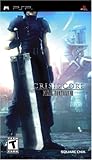
Love it or hate it, it's hard to deny that Final Fantasy VII at least moved the long loved series forward on the technical level. Today the blocky 3D figures of Cloud, Tifa and company might not be the easiest on the eyes, but back when it originally released in 1997 it was a sight to behold. From there on out, each subsequent Final Fantasy game managed to push the limits of the hardware for whatever console it was released on, and with Final Fantasy VII: Crisis Core, that statement still holds true.
Not only is Crisis Core one of the best looking PSP games on the market today, but it also marks the best spin-off Final Fantasy title that has come out of Square's big Final Fantasy VII Compilation effort, easily blowing away such dredge as Dirge of Cerberus. I'd even say this marks the best non-main Final Fantasy title to date, so the big fans of the series shouldn't be disappointed in the least.
For those of you that haven't been madly anticipating the title, Crisis Core revolves around the tale of Zack, a character only mentioned thru back-story in Final Fantasy VII. Friend of Cloud, fellow Soldier member, and love interest for Aerith, Crisis Core focuses strictly on Zack. There is no stone left uncovered when it comes to his history with Shinra, Sephiroth, and others.
Fans will be happy to see plenty of cameo appearances by other recognizable faces, but Square Enix does a great job of reigning themselves in, and they manage to not contradict the events in later titles, as any good prequel should. Instead they manage to fill in the small holes from what little we already know about Zack, and expand upon that story without being overly heavy handed in both dialogue and plot, a problem that many had with the CGI film Advent Children.
There is some beautiful CGI featured in Crisis Core as well, but it manages to actually take a backseat to the story, and outside of a couple scenes Square Enix manages to keep the action as realistic as possible (as real as magic and what not can get). This helps to ground this tragic tale into the hearts of fans that have had an emotional investment in these characters for nearly 10 years.
However, while plot and story make up the substance of any good Final Fantasy title, how does the game actually play? Taking away the standard turn based RPG mechanics of most Final Fantasy titles, Crisis Core uses a real time action style similar to the Kingdom Hearts titles by Square Enix. However, while many lament that you can simply "button mash" your way thru most of KH, that tactic will get you killed quickly in Crisis Core. Along with your basic attack button you also have a dodge and block (Square and Triangle), and the real trick to most fights is anticipating an attack by watching for a telltale attack animation and dodging at the right time. When it's successful you can even end up behind your opponent, which will allow you to land critical hits until the enemy reorients themselves to face you.
Along with your basic attacks you can also equip materia, small stones that played heavily into the magic system of the original title, that allow you access to various spells. All of the standard spells appear here, and you can level up each materia to a maximum of 4 levels. Later in the game you'll gain the ability to create new materia by fusing stones together, and eventually you'll gain the ability to toss items into the mix. On top of this, some materia will contain various bonuses, such as a percentage added to HP or MP along with just the standard magic attack, so you'll want to experiment with as many combinations as possible.
You're also given two equipment slots (later expandable to four), and with these you can add on items found throughout the game that can either enhance your HP, MP, and AP, or even block or lessen certain status effects. All together, you can pretty much customize Zack however you see fit, but I found that as I advanced towards the end that I felt a bit overpowered, especially considering how easy it is to hit your HP cap early on using items and materia.
The L and R buttons handle cycling thru magic on the battlefield, and while certain fights can feel a bit frantic, you shouldn't have any trouble getting the hang of things. Simply run away from your opponents if you feel you need more time, since most magic attacks have a limited range. The biggest hassle has to be clicking on items and then cycling thru the list of available items just to find a much needed remedy or elixir. However, as you get the hang of combat you should find yourself adapting to everything with ease.
All battles are random, and at times a bit too frequent for my tastes. Also, simply running away from a battle is a difficult since you have to look for the exit, especially in side mission areas where everything tends to look the same. Enemies aren't particularly smart or challenging, but if you're not paying attention they can gang up on you quickly, and you'll take quite a beating for it. If you opt to complete some of the harder side missions later in the game you'll come across the cheapness of the spell Death, which always hits you unless you manage to interrupt the spell by attacking the caster. Otherwise, be sure to have plenty of Phoenix Downs on hand, which you need to cast on yourself prior to being killed.
The main storyline isn't particularly long (or challenging) but at every save point you're able to access a ton of side missions, laid out in groups depending on the "story" involved. There isn't actually a lot of story involved in the quests, and certainly nothing that impacts the main storyline, but they provide bite sized sections of combat perfect for players wanting something quick to run thru on their way to work or while on a lunch break. There are over 300 side quests to make your way thru, and they end up being the best way to gain summons, equipment, and rare materia throughout. At 20 hours on my final play, I had only thirty-eight percent of the side quests finished, so needless to say these missions can keep you busy for quite some time. For the most part they're also fun to play thru, but a bit repetitive. It's not until you run into the "very hard" section of quests that you'll find some cheap enemy tactics that might be a bit hard to stomach for most casual players.
The soundtrack of Crisis Core is also worth noting. While many can argue the merits of Final Fantasy VII's original tunes by Uematsu until they're blue in the face, it's hard to deny that most of the tracks featured in Crisis Core are solid, if not spectacular. A few of them end up being remixes from the Final Fantasy VII, but they're just as good, if not better, than the originals. In particular the opening theme at the title screen is fantastic, and the remixed melody of Aerith's theme is outstanding as well. Kudos to Takeharu Ishimoto for not simply rehashing that stuff we've heard over and over again, and really breathing new life into some fond memories of these familiar themes, along with introducing some fantastic new tunes.
Along with the musical score, Crisis Core's voice over work is pretty well done. I never felt that any one particular voice stood out as something incredible, such as Balthier from Final Fantasy 12, but on the other side of things there wasn't a bad apple in the group. Something to note is that Aerith finally receives a decent voice actor (not Suvari or Moore), and it finally manages to fit her character quite well.
I had a few other minor issues with the game that don't fall into any particular category, but here they are. While you can skip the FMV animations for summons, you can't skip them for the limit break attacks, which are nearly as long and far more frequent than your summoning spells. Also, the slot reel system needs a far better explanation, and having it tied into your leveling system is pretty confusing.
Basically, the reels are always spinning while in combat, with certain number combos granting you status bonuses, such as no casting cost, limited invincibility, and so on. However, when the faces on the left and right reels match, the slot reel (or DMW) will take over the screen, usually ending up with the middle reel matching the left and right, which will take you into a limit break depending on which character is showing. These can also lead into a separate reel that contains your summons, and if you manage to match faces on that reel you'll perform a summoning attack instead. Along with this, when you manage to hit all 7's on the reels during a limit break / summon situation, Zack will level up. Also, if you manage to hit the same two numbers side by side, you'll level up an equipped materia depending on the order you have them equipped. For instance, if you hit a 5 in the left and middle reel, then you'll level up whatever materia you have equipped in the fifth slot of your inventory.
Confused yet? It's actually pretty simple, but the mechanics of getting the DMW to pop up are a pretty big mystery. Above the slot reel you'll have a colored meter that represents your current limit break state. Most of the time this meter will stay normal, however certain events (and even a limit break) can cause it to change, all the way up to Heavenly. At this point you'll encounter more matching faces on the reel, which in turn will cause you to perform more limit breaks or summons. Once you enter that full screen DMW mode, the current level that your limit break meter is at will decrease, and it will eventually fall back to normal. On top of all this is the SP meter, which rests above both of these things. The best I could figure is that SP is basically experience points. Each enemy you kill will give you a certain amount of SP, and I figure this is the way the system keeps track of when you SHOULD be leveling up. There's nothing in the game that tells you when you'll level, but the pace is pretty spot on for the story, so leveling isn't nearly as random as it seems.
So outside of my issues with the DMW system, and some minor things like the unskippable animations for limit breaks, Crisis Core stands out as not only a fantastic Final Fantasy title, but one of the best games on the PSP to date. That's saying something in light in the pretty stellar year the system saw in '07, so hopefully you system owners out there will take my word for it and pick this one up. Great action in small bursts, and a fairly level headed storyline that won't leave you scratching your head. Even if your memory of Final Fantasy VII isn't as fond as others, Crisis Core still manages to be a fantastic game worthy of your attention.
Get more detail about
Crisis Core: Final Fantasy VII with Limited Edition UMD Case.